10 Lessons I’ve Learned Abroad in Scotland

People always say studying abroad will be ‘fun’ and a ‘great opportunity.’ But studying abroad this fall in Scotland has been much more than this. I simply can’t put into words the warmth and love I feel for the people I’ve met in just 4 short months. From the crazy old lads at the pub down the street to my wonderful 11 flatmates– everyone taught me lessons that I will carry on for this rest of my life. I decided to write about the 10 things that Scotland has taught me, stories included. Some are silly* and others serious– all equally important in the journey of ones life.

*Friendly reminder that the legal drinking age is 18 in the UK (unlike the U.S.) and would like to take a moment to apologize to my parents for my craziness.

10. Scottish slang and accent is basically a whole different language

tumblr_mbfubi55hz1qba5clo2_250One of the laziest reasons I chose to study in Scotland was the fact that it is a native English-speaking nation. I love the idea of learning new languages but it’s not a strong suit of mine and I wanted to feel comfortable. Little did I know “English” in Scotland is a whole different language. Add on the goofy Glaswegian accent and you’re in trouble. It took 4 months to learn a good amount of the slang and practice a mean Scottish impersonation but it was fun.

9. Cab drivers are your worst enemy and your favorite therapist

Two parts to this one. First, never jay walk kids. Secondly, don’t call your parents at 5 in the morning telling them you got hit by a cab — it may result in a mini heart attack. But more importantly, don’t trust a cab driver to not hit you when you step off the sidewalk cause there’s a 93% chance they’ll just knock you over. I am a victim of this 93%.
Unlike the majority of cabbies that will run over your foot at 3 in the morning, there are a special few that I like to label as therapists. Cabbies are strangers who don’t judge and listen not because it’s their job but because they have nothing better to do in the time it takes to drive you to your destination. My favorite memory of a “cab therapist” was the dreadful Sunday morning my Macbook hard drive crashed. I had a 15 page final paper for my Scottish Enlightenment course done — it was due on Monday. I lost it all and the Apple store couldn’t help. Frantically, I jumped into a cab and started sobbing at my own misery. The cab driver listened to my story in between my weeping and calmed me down by being empathetic but also realistic in reminding me that life is bigger than a 15 page Scottish Enlightenment paper.
If you are ever in need of a quick 10 minute anonymous therapy session jump in a cab. It’ll save you hundreds of dollars and you’ll meet someone cool along the way.

8. Haggis is delicious, just don’t ask what is in it

Unless you crave sheep stomachs and juicy livers I recommend to never ask a Scot what goes into making the traditional meal. But I do recommend being a brave wee Lassie and trying it once in your life. If you are scared you can eat it fried and drenched in sauce– as Ben and I did in Edinburgh.
On a broader spectrum, I’d like to think eating haggis is a metaphor for living in the present. Some moments in life you don’t want or need an explanation. Just trust your gut (or hunger in this case) and leave it up to fate. Don’t try to explain how things work or try to plan a journey, just pick one and experience the wild twists and turns life throws at you.
Yes go ahead and try the damn haggis it’s not going to kill you, neither is trying new and adventurous things in life.

7. Music is universal

I’ve always seen music as a meditative and social tool in my life. From Arctic Monkeys to Dire Straits, music provides a is a path to your hidden voice.  Most importantly, it allows you to connect with the people around you.
There’s nothing like being cramped in a small quaint pub filled to its brim with people singing in their raspy loud drunk voices to the melody of Galway girl or the verses of Sweet Home Alabama.
So grab the speakers and play what your heart desires.

6. Crash as many Holiday staff parties without getting caught10436226_738738256219068_626479831255152989_n

The two funnest nights I had in Glasgow were the nights my friends and I ‘accidentally’ crashed Christmas staff parties. First one was at the local bar in the west end. A huge oil company took over and turned the little pub into one of the craziest parties I’ve ever seen. The company bought endless rounds of drinks– one of the few positives of petrol’s wealth. And the night ended in a huge Hilton suite eating a room service feast and jumping on the beds till the sun rose.
The other party was at the Tennents’ brewery. If you have been to Scotland you would know Tennents is a very important word. It’s “Scotland’s favorite pint” and is extremely cheap compared to all the other imported beers. Not too shabby tasting either. Anyways, our flatmate Davide worked as an intern this past summer and is currently still doing work for the brewery. He took the whole flat (about 10 of us) on a tour around the factory. It ended with a taste session of course. But little did we know that wasn’t going to be the last pint of the night. Davide took us to the staff party which was being held in the top of the factory. The old quaint pub overlooked the bottling room. We were overwhelmed with hospitality. We walked in and all the old women grabbed is to dance to old 70s funk as we were poured pints after pints. We all danced for hours and had laughs with all the staff– from the secretaries to the CFO.
Lesson learned: if you ever have the chance crash a holiday party. You will have a night you will always remember.

5. You can never give too many hugs

I was so worried when I found out I was going to be living in a flat with 12 strangers. Little did I know those 12 strangers were going to be 12 of the coolest most genuine people I have ever met in my life.
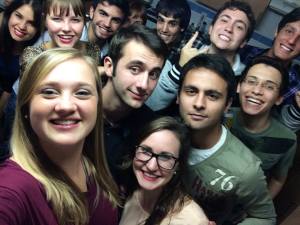
 10610937_10204479564936366_6101241565250778688_nAfter we got past our little shy awkward selves, our flat turned into a crazy and hilarious place to turn to for support, a good laugh, a place to rant, or to get a hug after a long day.
What helped our flat get to this beautiful point of comfort was hugging. Hugs and kisses break the barrier and make you realize you have someone there.
So give out as many hugs and kisses as possible in your life. Never doubt that it’s a perfect moment for a hug.

4. Travel is important but immersing is the key

Yes, while studying abroad in Europe you should take the opportunity of cheap flights and youthful energy to travel all around. I had a great time getting to see friends studying abroad in other cities and exploring by myself. However, more than I would like I was stressed about money and exhausted from long bus rides and finishing homework on the plane ride home.
My solution– stick with the country you chose. Explore the whole country from coast to coast. See how people are in the north versus the south. Taste the different whiskeys and meals of each clan. The key to gaining a once in a lifetime experience living abroad is to actually live there. Instead of having the mindset that it’s just a vacation or an extended visit– convince yourself that its permanent. This allows you to immerse yourself in the culture and gain friendships that will last a lifetime.

3. Skirts look damn good on men 

Enough said. Thank God for kilts, beautiful ginger lads, and the Glaswegian accent. Hereby declaring the Scottish nation as the most attractive in the world.

2. Talk about politics, religion, sex, and all the things you were taught were not polite

You are always told to never talk about politics and sex on the first date or with strangers. But I say that is total bs. How are you supposed to learn about someone’s values, characteristics, spirituality unless you talk about the things that make us all similar and different at the same time?
Politics and sex were our two favorite conversations in our flat. Let’s just say I know more about those 12 strangers than I would necessarily like to but I’m glad I do. With every conversation and every story told we all respected our differences while learning how similar every human being is. If you put 4 Americans, 4 Brazilians, 1 Catalan, 1 Swede, 1 Chinese, and 1 Italian in a room you get a wild ride of opinions and stories.
So share your story– with all its crudeness and insecurities. That’s what makes us human.

1. Scotland is beyond beautiful 

I have been blessed to travel the world this past year. I’ve been on 26 flights, traveled to 7 countries, and explored over 30 cities in the past 12 months. I am forever grateful for the adventure of a lifetime. Each country taught me new lessons but Scotland is one for the books. The people I’ve met and the stories I’ve gained I will remember forever. As cheesy as it is this is not a goodbye for me. I know Scotland will be home for me at some point in my life– let it be post-graduate, work, or to raise a family.
So see you later Scotland and Slaandjivaa.
10710925_10204386806177455_887575557741059217_n

Postscript: Nonnie and my Bengali Grandmommy

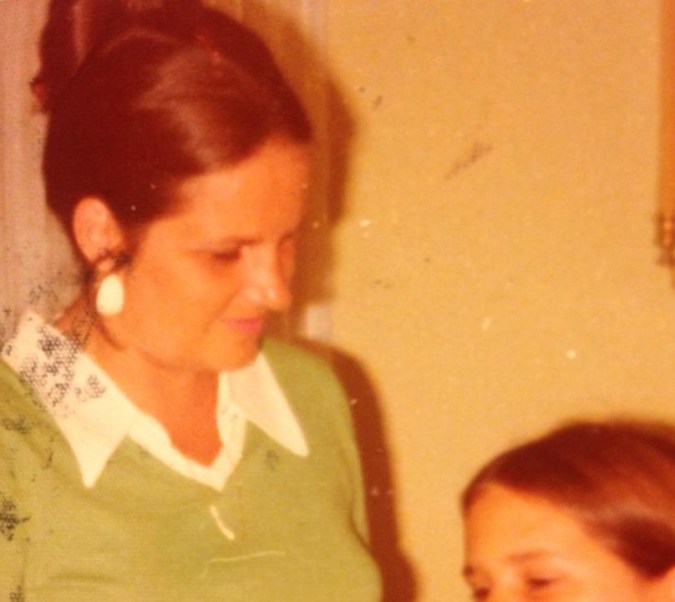
There are few memories I have of my grandmother. Her raspy voice that came alive with her loud and colorful laugh, her terrible habit of smoking cigarettes, the crossword puzzle in the New York Times that she would stare at for hours on a Sunday morning, the continuous family joke of arranging a marriage for me with the cute French boy next door, and our silly fights about why I would have to wear a dress on Easter or any other event held in her home.

Surprisingly shining a smile even though I am in a dress-- rare scene

Surprisingly shining a smile even though I am in a dress on Easter– rare scene at the Curlin estate

I hate that these are the only memories I have of my Nonnie. I can’t help but to be angry at myself and absolutely devastated that I will never get the chance to hear her laugh and have a silly fight with her one more time.

However, I am blessed to have gotten the chance to become friends with the people dear to my Nonnie. Every time I hear a quirky story or witness a tear shed about her I learn something new. Instead of those five basic memories, I have been able to create a lifelong image of my grandmother in my mind and in my heart.

My mom and I have traveled to Bangladesh and India this past month to retrace my grandparent’s steps. We stayed with Mustari, my grandmother’s best friend, or as my mom has coined her, my Bengali grandmommy.

Mustari and Nonnie met through their husbands, my grandfather and Atiq, both young doctors busy at works in the late 60s and 70s in Bangladesh, saving lives. Mustari and Nonnie did not sit back. They strived– they listened to women who were surrounded by loss and heard their cries. They came up with an innovative model– one that gave women their voice, body and hope back. Mustari and Nonnie cofounded Concerned Women for Family Planning (CWFP), what today is one of the largest organizations working with family planning and development for the women of Bangladesh. Their slogan, coined by Mustari and Nonnie when they started, says it all– “Because women matter.”

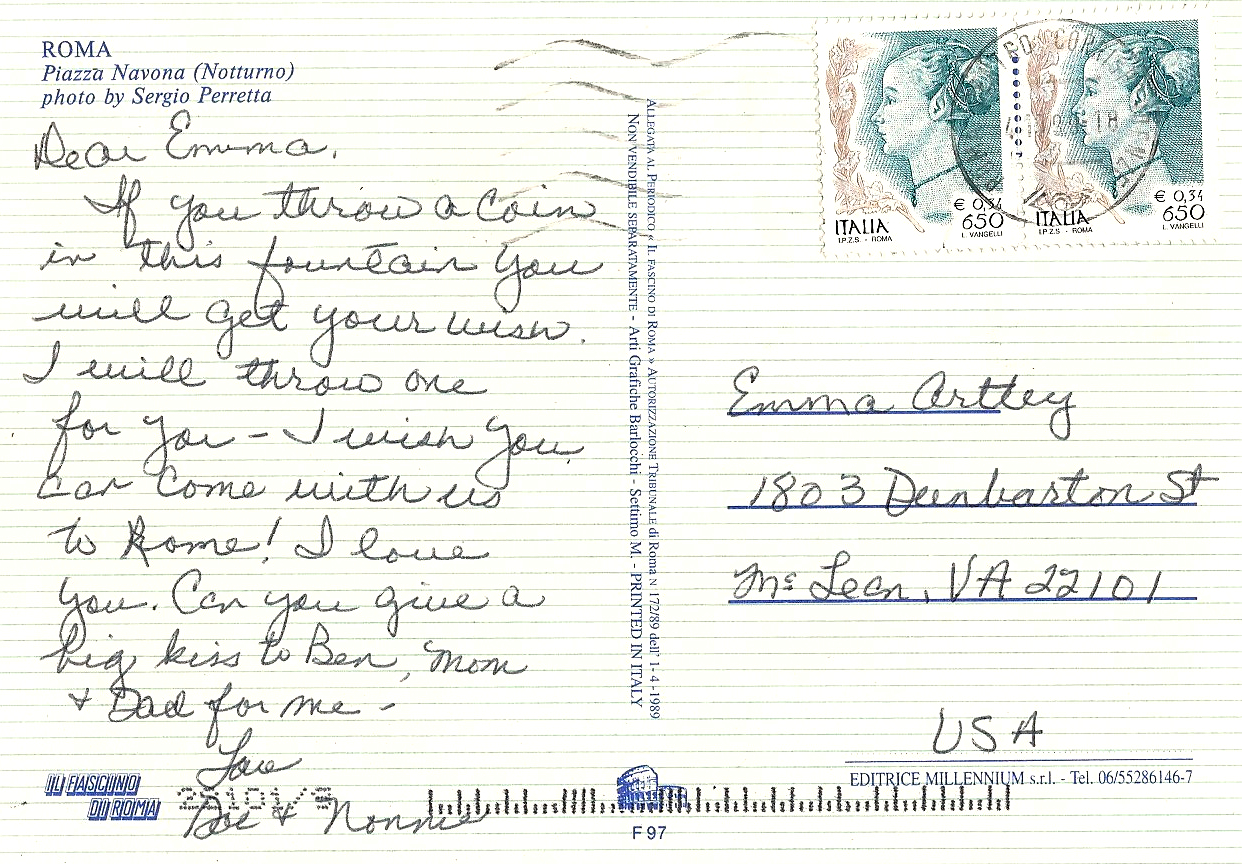
Letter from Nonnie from the Piazza Navona (Rome). "I will throw a coin in for you- I wish you can come with us to Rome! I love you."

Letter from Nonnie from the Piazza Navona (Rome). “I will throw a coin in for you- I wish you can come with us to Rome! I love you.”

I already knew this little legendary plug for my grandmother’s legacy coming into this trip. I have written 5 term papers that involved her accomplishments, quoted her in assignments, researched her name into the late hours of the night, and sorted through every postcard from all around the world that she wrote to me as a little girl, to find some hidden message. There is nothing. I seemed to have driven myself crazy the past couple years trying to discover more about my grandmother so that I could explain — myself. Her articles, books, letters all show her courage, intelligence, and compassion but they leave out the real truth. They leave out her warmth, her hilarious personality, her drive that could run over anyone in her way, and her stubbornness to help each and every woman who came to her. All of which I could not have come to known without meeting my Bengali grandmommy, Mustari, early in my adult life.

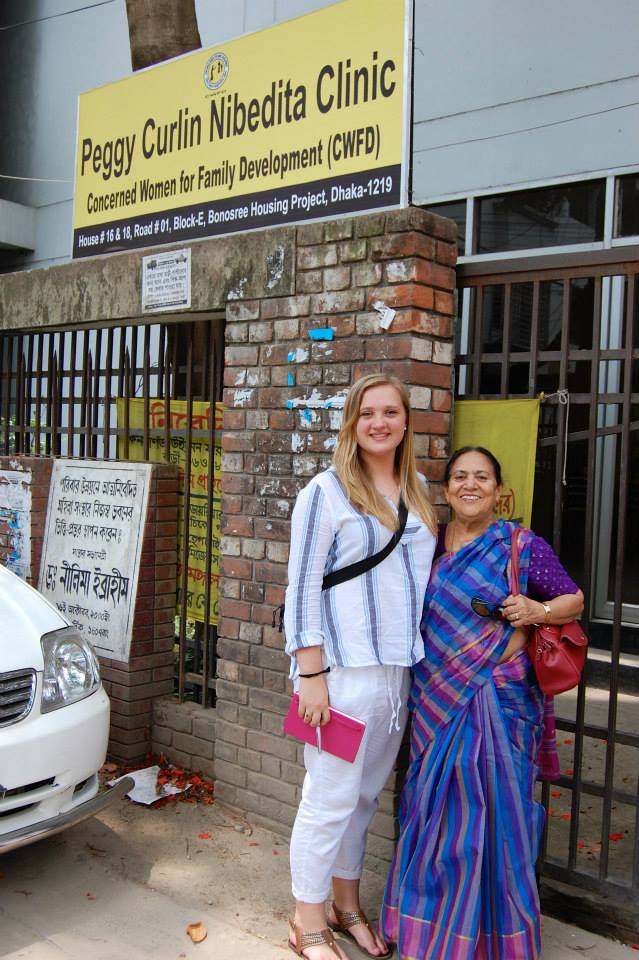
Mustari and me at the CWFD clinic in name of my Nonnie

Mustari and me at the CWFD clinic in name of my Nonnie

Even though we only visited Mustari’s home for a week we all became very close. Closer than just getting to know one of my grandmother’s dearest friends. She fills in a role for my mother and me that we longed to have ever since we lost Peggy eight short years ago. Mustari, Mom and I shed tears together as we bravely admitted to ourselves and each other that we missed her more than we could bear. Sure, I lost my role model, my stubborn and compassionate grandmother that September day eight years ago. But my mom lost her own mother,  woman she could share her daily accomplishments and defeats with. Mustari lost her best friend that September day eight years ago. That pain and loss never goes away.

My point in this last post of our blog is not to remember a woman that we all knew was one of the kindest and bravest souls to walk this earth, but to realize that there is something better than remembering. There is doing. There is loving. There is growing.

Mustari Khan and my mother are unbelievable women. Mustari fills this ‘Bengali grandmommy’ role to countless girls and women around the world. She fights for their rights, their voices, their ownership of their health and body. This year marks the 40th anniversary of CWFP, now known as Concerned Women for Family Development. Forty years have passed since Mustari and my grandmother decided that women matter. Mustari and CWFD continue to grow and to empower the communities they are helping. They are doing. They are loving. They are growing.

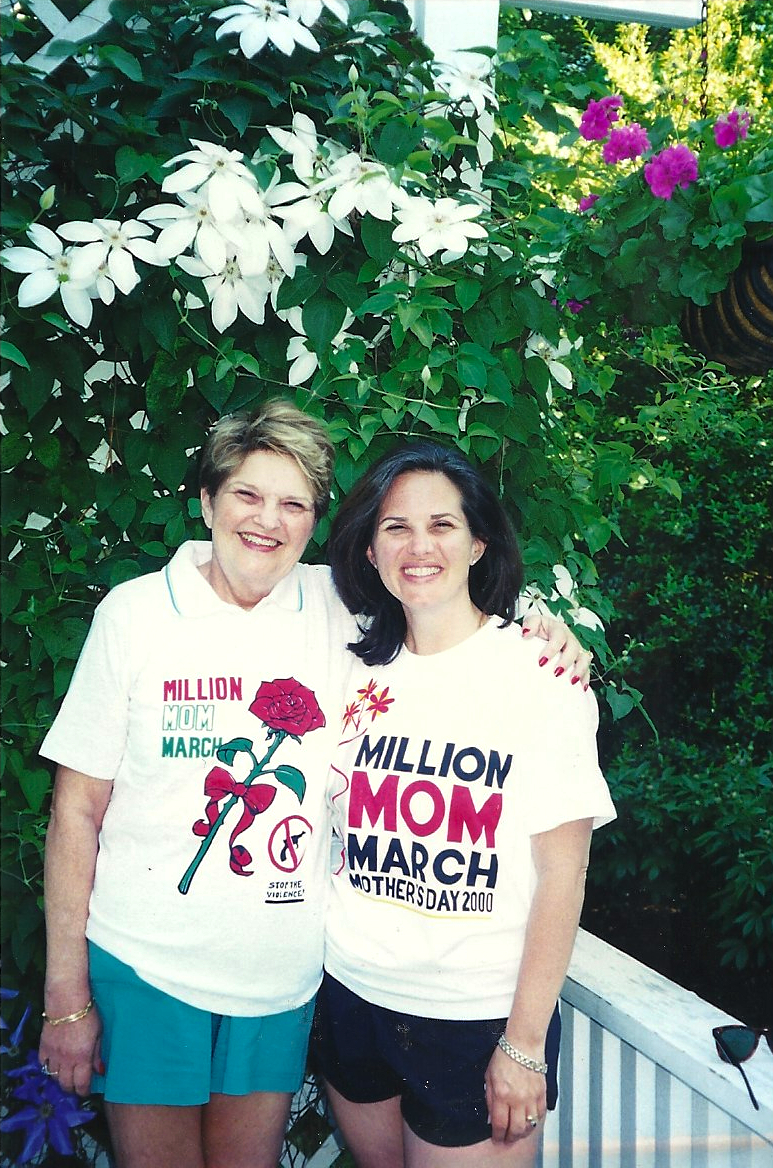
Mom and Nonnie

Mom and Nonnie, Million Mom March, DC 2000

Our family has changed a lot over the past 5 years or so. My brother has grown to become one of the most caring, gentle, and sympathetic men I know. He is the perfect advice-giver in my most idiotic stages of heartbreak and the best company to have alongside any of my tame teenage rebellions. My dad is the wisest man I know. As we sit in complete silence sitting on the back porch, I learn more than I can ever dream. My mom, on the other hand, amazes me everyday. She grows, loves, and does more in one day than is humanly possible.

Every day we as people go through loss, defeat, pain, and longing. We remember but sometimes we forget to grow. We forget to love what we have in front of us. We forget to do what needs to be done for the people who ask for help.

My Nonnie was an amazing woman. The most important gift she has ever given me is the opportunity to love the people who meant so much to her. My mom and my Bengali grandmommy are just a few examples of those precious gifts. The precious gift of the now.

In loving memory of my Nonnie, Peggy McDowell Curlin (1940-2005)

In loving memory of my Nonnie, Peggy McDowell Curlin (1940-2005)

Albert to Ashes, Dust to Dresses

On the last day in Mumbai, we woke up late and caught a taxi downtown from Juhu Beach.  It was Sunday, so it was considerably easier getting there and the taxi was a cost savings over the private cars the hotel charges a half or whole day.  The cabbie dropped us at the Chhatrapati Shivaji Maharaj Vastu Sangrahalaya, formerly known as the Prince of Wales Museum, very near the Gateway to India.  We joined the throngs of Indian families who were making a day of it, just as we used to at the Smithsonian on Sundays when our kids were young.  Once again, we were the only Westerners there and we were aware of what a special treat were receiving to experience this day without throngs of tourists. We explored the painted miniatures and the black stone sculptures in the heat — no air conditioning for these priceless works of art, though they didn’t show the worse for wear — and then across the street to the National Gallery of Modern Art in Mumbai for a wonderful surprise.
amrita-02Amrita Sher-Gill studied at the Ecole de Beaux Arts in Paris and returned to India in 1934 to experiment with several styles, always gravitating towards her experiences as a woman in India.  The Gallery hosted a fascinating retrospective of her work on the 100th anniversary of her birth, and since the exhibition is closing this week, it was filled with serious art lovers who were taking their time with the paintings, letters and other memorabilia.

The plan was to leave the exhibit and head back to the Gateway of India and the Taj Hotel, since the Mumbai Beatles distracted us from our touring the day before.  But Albert inserted himself into our day.

“Where do you want to go?” he asked.  “I can help.  I’m a teacher at the University of Mumbai.”  Was it the credential or Albert’s infectious smile that made us trust this man on the street?  He continued to ask us questions.  Where were we from?  Do you like to see temples?  Would you like to see the Ganesha temple close to here?  Come, he says.  I’ll take you.

And we followed.

I know that my dear readers are now shaking your heads in disbelief. But it was a big, busy street and Albert was so sincere.

Albert led us past the old synagogue, past the ho-hum mosque to a small temple dedicated to Ganesha, directly across the street from the Cricket stadium.  Immediately inside the temple gates, Albert explained that we were looking at an ancient Muslim burial ground and that this temple grew around it.  We are all sisters and brothers, he explained of the multi-faith community of this old street.

We could see a small temple inside the gate adjacent to the burial ground.  A priest performed a ritual with water on a banyan tree that grew next to the silver lingam and the statue of Ganesha.  Albert asked permission for us to come inside the temple with the administrator, Monesh.

The pews faced an ironworks of some sort…

“Welcome!  You are my sisters,” Monesh greeted us.  We said our Namastes to the priest and spent some time watching the ritual.  Then Albert took us to sit in what appeared to be pews, except that they faced what seemed to be an ironworks of some sort.

“This is where they burn dead bodies,” Albert explained.

Wha?

“If you are a wealthy man, they burn the body with sandalwood — very expensive.  If you are not so wealthy, mango wood.  If you are poor, banana tree.  It takes three hours for a body to burn.  See?  One is burning there.”

“Come see.  Come see!” Monesh encouraged us to take pictures.  The proud administrator showed us how they collect the ashes after they have cooled, and where they are stored until the family comes to take them to the Ganges, if they can afford the trip.  Here is a burial shroud.  There is where is they measure out the wood.  Please sign our guest book. Here — you look hot, please accept this cold Limca as a gift from me.  Thank you for coming to visit, Sister!

IMG_4136

Albert, Monesh and their two sisters

Over the ice-cold Limca in Monesh’s office,  we had a great conversation with Albert, Monesh and a young Muslim man who worked at the temple, Siddiq, about the crazy spaces between people of faith, agreeing that we are all searching for the divine within and between people. They told Emma not to get married until she is finished with her studies.  I made a small donation to Monesh to help defray the cost of the cremation of the poor.

It was time to leave. Albert negotiated a really good price to Bandar Linking Road, the Fifth Avenue of Mumbai.  There, we dusted ourselves off — literally — and got down to the business of last day fashion purchases before we leave this magnificent city.


Scary Ferry with the Mumbai Beatles

We decided to go five-star for our stay in Mumbai.  Because when you travel to New York City, don’t you really want to stay at the Plaza? After a day of touring the City Palace in Jaipur and flying Indigo to Mumbai, we checked in at the JW Marriott at Juhu Beach, swam in the hotel pool, ate sushi for dinner, slept in preparation for the next big day.

Busy Mumbai

Busy Mumbai

First stop, Elephanta Caves.  It was a long car ride to India Gate from where we are staying, but the trip was informative and comfortable, thanks to Yogesh, our driver.  Mumbai reminds me of Kolkata.  We would visit when I was as a child living in Dhaka to spend days shopping on the streets of the teeming city, swimming in the hotel pool, and reading our newly purchased Tintin and Asterix comic books.  Like Kolkata, Mumbai has the crumbling old Victorian buildings next to the intricate alleyways of the shanties and shops that were built around it — an immediate, visual archeology of India after the Raj. We arrived at India Gate,where the Brits came and then the Brits left India. Next to the gate, we caught a ferry to take to the island of Gharapuri on the Oman Sea to see the temples that were formed out of the rock in the mountain somewhere between the 6th and 8th century AD.  We paid the 20 rupees to sit on the top level of the little ferry, a fee that is only applicable to foreign tourists ( we’re now used to this in India — every entry fee we paid for monuments and museums are structured so that foreign tourists pay more.)  Off we set with Indian families dressed in their best saris and jewlerly for a picnic on the island.  Once again, Emma was asked for her photo by three young men sitting opposite us.

Emma and I dubbed them the Mumbai Beatles.

Emma and I dubbed them the Mumbai Beatles.

Menod spoke English well, though he was shy about it.  He explained that he and his buds from work came by train from a city 800 kilometers away for Menod’s interview with the bank headquarters in Mumbai.  They decided to make a holiday out of it.  Emma and I decided they looked like the young Beatles.  Menod was Paul, one was John and the other George.  It seemed fitting that Ringo didn’t make the trip for spiritual enlightenment — didn’t it always seem that Ringo just tagged along to India for the jewelry and ganga?

The monkeys of Elephanta

The monkeys of Elephanta

Off the ferry, we opted to ride the small children’s train to the very bottom of the climb up the mountain, just so that we could say that we had ridden planes, trains, automobiles, boats, rickshaws and baby taxis on this trip. Then the climb to the caves at the top of the hill. There are monumental steps leading up to the caves, covered by blue tarps strung by the merchants that line the stairs.  I shouldn’t have predicted that Mumbai wouldn’t have monkeys playing as they did at Jas Villas, because if you string a tarp, there will be monkeys jumping on it in India.  The walk up the ancient stairs was long and hot. We passed the Beatles, who opted to have lunch at a restaurant about half way up the hill. We soldiered on, downing a liter of tanda pani (cold water) on the way. It is too hot to eat in the midday in India.

We climb another mountain

We climb another mountain


IMG_4089

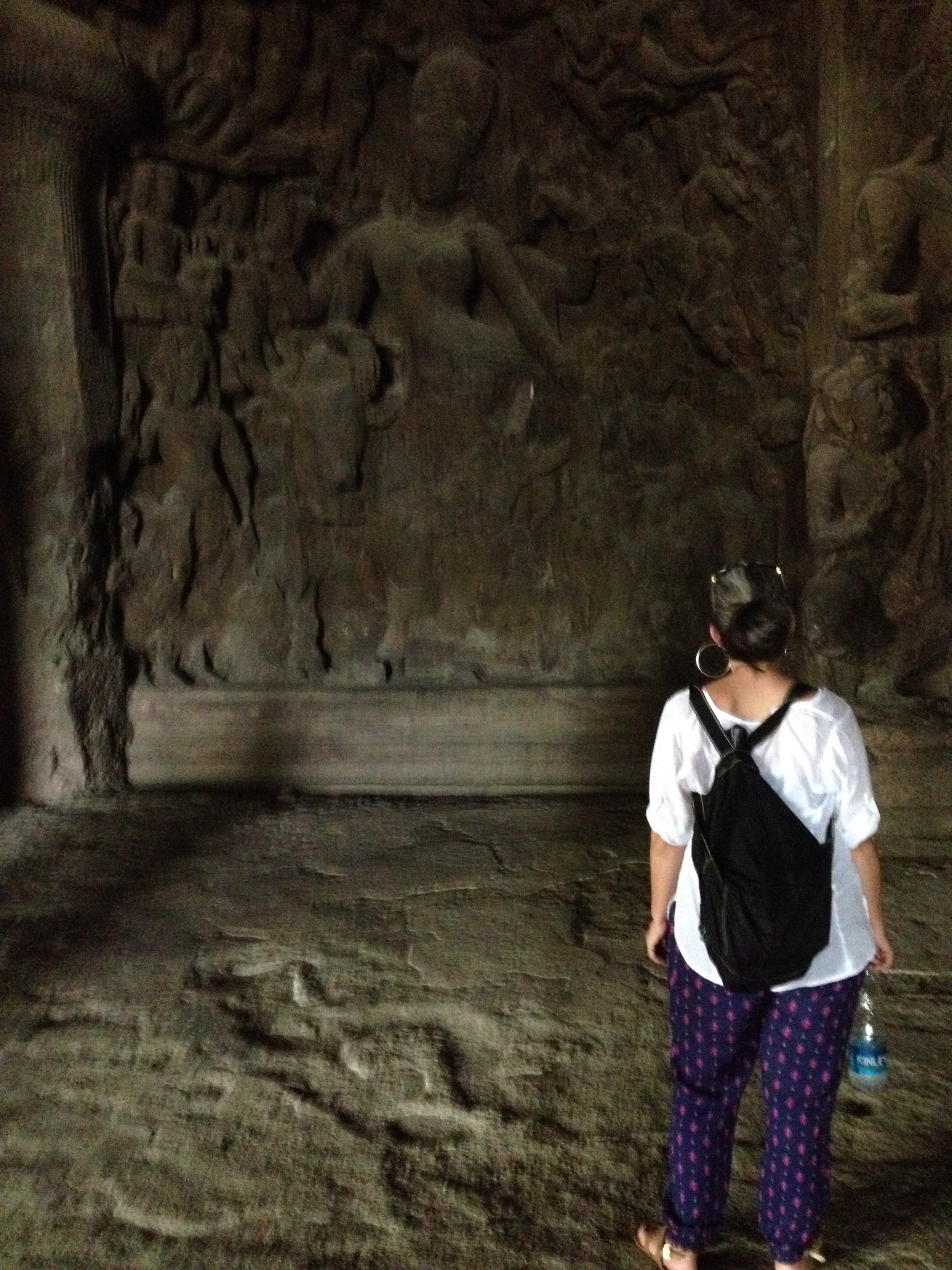
The caves are amazingly grand.  The first cave has a carving of the three aspects of Shiva, the creator of joy, the terrifying destroyer, and the master of positive and negative principles of existence and the restorer of harmony. But in each of the larger caves, I was drawn to the chapel that held the lingam, a cylindrical stone representing the all-encompassing energy of God.  There, in the dark chapel, one experiences peace that comes from a singular focus on the divine that is not manifested in human form, but in this universal symbol of dynamic energy — powerful, all-encompassing, eternal and radiating into everything in the universe.

Peace, tranquilly

Peace, tranquilly

The strong wind whipped up many more whitecaps for our journey back to Mumbai.  Emma and I and Menod and his friends sat on the lower level of the bow of the boat.  It was rough and then got even rougher , the waves splashing us repeatedly so that we were soaked.  Curiously, I wasn’t that frightened.  Was it the reassuring presence of the Beatles, who laughed with Emma at every splash? Or the tranquility that came from hiking the mountain and entering the cool dark places to be in presence of the eternal?

Redemption in Jaipur

It was a bit of a risk to post what I felt about our trip to Delhi.  I felt a bit like an ugly American.  I felt guilty.  It was compounded by our first evening in Jaipur, unfortunately.

After resting from our uneventful trip from Delhi on Air India — only 50 minutes — our driver took us to a textile emporium and I found out that Emma channels my mother in more ways than in looks and passion for helping people.  She really, really, really loves textiles.  What an entertaining day it was as a young man from Jodphur with a deep American accent told us about how sindhi cloth is made, the time it takes a woman to make the intricate cut work in appliqué, the number of months it takes to make this type of quilt. We leave the warehouse with Emma’s Junior year college dorm room blinged out with an elephant tapestry for the wall and a blue bedspread embroidered in gold.

Ganesha

Emma is obsessed with elephants

Emma is obsessed with elephants.  She’s already bought four small ones — the last a tiny one in marble from Agra.  One major goal for her trip to India was to ride an elephant.  I asked and was told that Chowkidani is a restaurant where you can ride an elephant.  Off we set.

If I’m being kind, I would say that Chowkidani is the Indian equivalent of the Folklife Festival in Washington, DC every summer.  There in a tired, dusty and completely concrete side-of-the-road resort, you can see what is touted as authentic Jaipur culture.  Or about as authentic as the Epcot Center is to French culture at Disney World.

We rode the sad elephant.  It was an odd combination of disappointing and mortifying for both of us. As a consolation, Emma got more mendhi, this time on the tops of her hands, and once again was the subject of many a family portrait with people who are curious about this tall blonde girl.  She is a trooper, most likely because it gives her a chance to introduce herself and ask where the children go to school and what their names are.

On the ride home, we dissected our feelings.  We long for connection and authenticity.  “I could have stayed at the girl’s center all day,” Emma said about her time in Bangladesh.

The monkeys in the hotel garden brought us a fresh new day the next morning, playing on the canopy over the windows at the hotel.  I was up, as usual, at 4:30 am, welcoming the cool morning and the time to think and write.  Chai at 6:30 outside and after a hearty breakfast with a German family at the pool, we joined our driver for the day of touring.  The first stop:  the Monkey temple and Surya temple, where we experienced redemption.

IMG_3979

On the way to Surya temple

The long, winding road to the monkey temple gave us an amazing vista of the city.  Cows and pigs, small children and boys on scooters greeted us warmly at the first temple, in honor of Hanuman, where the monkeys lazed in the early morning sunshine.  Then, climbing more, we reached Surya temple, where a priest said prayers while his 9 year old boy sat with him.

What a welcome at Surya temple by this sweet young man

What a welcome at Surya temple by this sweet young man

“Come, come!” he shouted to us as we respectfully perambulated the exterior of the temple until the ritual was completed.  And it was love at first sight:  Aditya Sharma, a 6th generation Brahmin priest in-training spoke almost perfect English, and explained (as his father chanted mantra) what was happening. He and his father live on top of this mountain, caring for the temple, built 3 centuries ago by a courtier of Jai Singh II.  His mother and his sister, who is six, live in town.  She had been bitten by a monkey. The prayers finished, his father joined in the conversation.  I wanted to take down his son’s name on my phone and lamented about my 50 year old eyes.  The priest said to wake at 3 am and do Suryanamaskar, “This way, the power comes to your eyes.”

It was a long way down the hill, but we had distractions as Emma was asked for a photo with a motor scooter guy.  Then on to the Amber Fort.

You don’t need a tour guide at the Fort – the signage is enough to understand and there are audio tours if you want more.  The place is simply amazingly beautiful.  Emma and I agreed that it was actually much more interesting than the Taj Mahal.  From there, to Hawa Mahal and then to a funny little city museum, north of town called Albert Hall, built by Sir Swinton Jacob.  There, amidst the dusty rugs and eighteenth century swords and Victoriana, Emma was once again asked about 5 times for photos with the kids in a family. Each time we learned the names of the children, their ages, told them our names.

Emma is asked to join family photos repeatedly in Jaipur -- a wonderful way to meet people!

Emma is asked to join family photos repeatedly in Jaipur — a wonderful way to meet people!

The driver took us to a hole in the wall for masala dosa, where we ate in the ladies and children’s room.  Then on to the very best sweet shop in Jaipur for jellabas, samosas, and chanachur for snacks.  Finally, home for a swim and a nap. A great day. Connection to the history, the people, the faith of this beautiful city.  Redemption.

Tomorrow, after a small jaunt to a few more sites in Jaipur, on to Mumbai.  Will the same hold true there? I know one thing:  there won’t be monkeys using the hotel’s window shades as a trampoline:


Family and the Kindness* of Strangers

So now we are tourists.  No home cooking, no beautifully crafted days of fun and learning.  We’d have to do this on our own now. I am acutely aware of how much I’ve been taken care of all my life.  Mom and Dad used to do this with Lincoln and Marty Chen and all four of us kids in tow when we lived in Dhaka in the 70s.  There were trips to Chittagong and Rangoon and a jaunt into Bhutan. Now there is the love of my life and ultimate vacation planner, Tom Artley who brings military precision to leisure so that I can completely relax no matter where we go.

I chose to stay at the Master Guest House in New Delhi, having had a wonderful recommendation from a friend of a friend and reading about it in a travel guide about India.  I emailed several weeks ago with the owner and his wife, Ushi, about dates and they arranged for their driver to meet us at the airport.

The heat is overwhelming here, worse than Bangladesh. Today in Agra, it was 109 degrees at 10 am.  Fortunately, we could leave the noise, the heat, the traffic by climbing the very long marble staircase to the roof of the house to our room named for Ganesha.  The house has nooks and crannies, open-air sitting rooms and odd landings.  Our room opened to a covered patio, where we met two sweet British tourists who gave us pointers about Old Delhi, and had our Indian breakfast of potato paratha, tea and mango lassi our first full day in Delhi.  Ushi explained that the house was built by her in-laws in 1947, after they came to Delhi and housed the extended clan until the dust settled after Partition.

Two hippies having dinner with the Brits and the swank guests at the Imperial

Two hippies having dinner with the Brits and the swank guests at the Imperial.

The first evening we were in Delhi, I decided that we should go to the Red Fort.  Huge mistake.  It is Indian vacation time here, so it was like being at Disney World.  Long, snaking lines greeted us, but I soldiered on.  We were tailed by a friendly rickshaw wallah — my “no, no thanks” did not disuade him.  Once inside the Fort, the walls created a little tunnel of infernal heat that we beat a hasty retreat from.  Luckily, our wallah was there when we came out, dripping in sweat.  “I take you Old Dehli,” he said and we obeyed.

Nothing can compare to being in a rickshaw in Delhi traffic.No one pays attention to traffic lights or lanes, just like in Bangladesh.  Everyone comes within a hair’s breadth of you.  Somehow, we haven’t experienced one fender bender though. It is a beautiful, if somewhat frightening dance.

Our wallah took us down every alley, every corner of Old Delhi, pointing out historical buildings and temples and famous shops in his broken English.  The breeze on our faces, the fascinating sites, the friendliness of our wallah made everything OK.  It was such an adventure and a conversation that we didn’t take out our phones to take a picture.  “It is my birthday today,” he announced at one point.  We had a friend.

The wallah turned out to be a friend who really needed much more money that we initially settled on as a price.  Oh, well.  He had worked so hard in the heat. I paid up.  He deposited us at a cab stand and we took one to the Imperial Hotel, thinking we’d see the old Raj and get a cup of tea.  Here we come, drenched in sweat and dust up the very swanky marble steps.  Thank God it is off-season, so they didn’t send us packing.  We had a delicious, but extremely expensive meal while listening to a tabla and sitar player play for us.

The doorman signaled a cab for us and we met Menku, an entrepreneurial driver in an old Ambassador, who announced that he would take us to the sights the next day.  After looking for a cab near the Master Guest House, and seeing that he had air-conditioning, we said yes.

IMG_3880

At the tomb

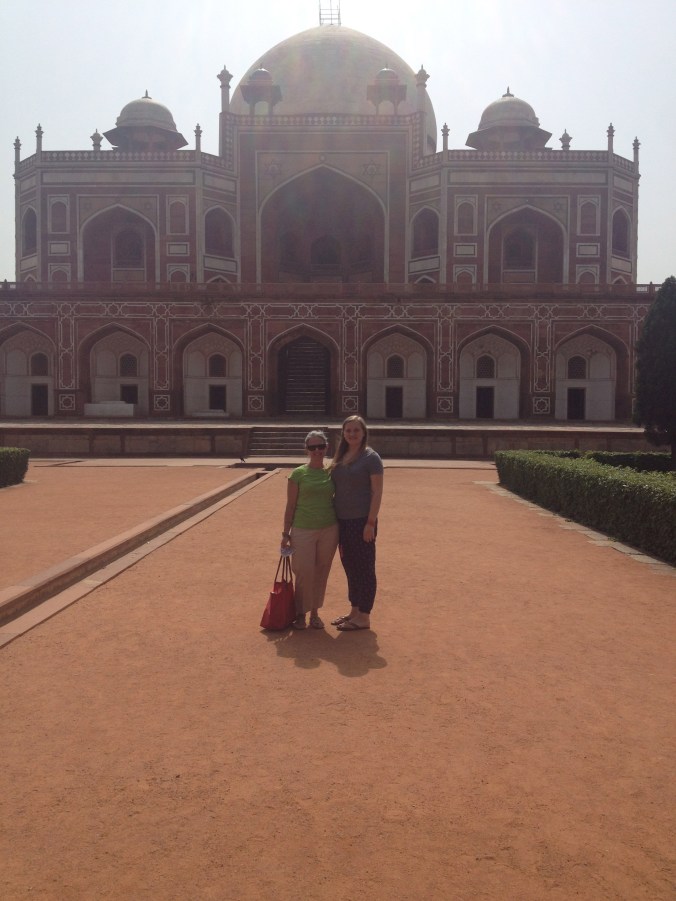
Menku took us to Humayun’s tomb, India Gate, Jonpath and Lasksmi’s Temple.  At the temple, we met a much older Indian couple as we tried to get into it — all the doors we tried were locked.  The wife was barefoot and the flagstone was burning. We set up a system where I would walk to a shady spot along the way, take off my shoes, hand them to Emma, who would take them to her.  By the time we all made it into the Temple, we were fast friends, even if we couldn’t understand one another.  Nevertheless, her husband took us to all the deities, bowing his head to the marble at each little shrine.  We both said “love,” when we were talking about God.

It was a wonderful, if hot and sweaty day.  “It is my birthday,” Menku announced as we arrived back at the Master Guest House.  We booked with Menku for Agra today.  When he asked for an advance, I hesitated and he was grossly offended.  I handed over 2000 rupees for gas and tax and arranged to see him at 5 am.

There he was this morning with a spanking brand new car — his uncle’s.  We traveled for 3 hours on the expressway, the early morning breeze whipping our hair into knots.  Along the way, we got to know one another better.  He lives with his extended family in a flat south of the city.  He showed us pictures of his wife and his two daughters on his vacation to a town in northern India — they are all dressed in coats and it looks as though they are in Vail, CO.  We talked politics, shared parenting challenges and sat comfortably in silence.

The Taj Mahal is a once in a lifetime sight, and thanks to my sweet Daddy, I saw it the first time when I was 6.  Dad and his parents and I had a big adventure. Menku arranged for a tour guide for us named Prince, who was a motor-scooter-riding, American-jeans-wearing, aviator-glass-sporting mover and shaker.  “Bollywooder from the 80s” as Emma said. But without the mustache.

IMG_3959After a decent if perfunctory tour of the Taj, Prince arranged for us to see real life marble carving and a gallery. I knew he was getting a kick-back of some kind from the merchants — a well-known practice in India.  Deposit a tourist and get a benefit.  And I hit this weird , cynical wall.  I was sick of the game.  This crazy space between us as targets that they needed to hit got tiresome, and Prince was the straw that broke the camel’s back.  Or maybe it was the heat.  How did Mom and Dad do this? I pretty much paid Prince well to get the hell out of Menku’s car.  No, we didn’t want to see the Fort, I begged off. It was too hot.  Buh, bye and thanks, I said to myself.

It was a good trip home in the AC. More interesting conversation with Menku, this time about life in America, disabusing him of the notion that there is no poverty there, a shocking concept for him since his friends who’ve been there have only seen wealth and opportunity.  “But if you work hard, you can earn money, yes?” he asked.  It was a difficult question to answer to his satisfaction.  Emma slept for an hour.

We had arranged to stay at a hotel near the airport so we won’t miss our trip to Jaipur tomorrow. When Menku left us at the doorstep, we paid him the agreed upon amount, minus the advance.  He seemed really disappointed.  And it made me very sad, this crazy space between us.

Members of the Wedding (Shower)


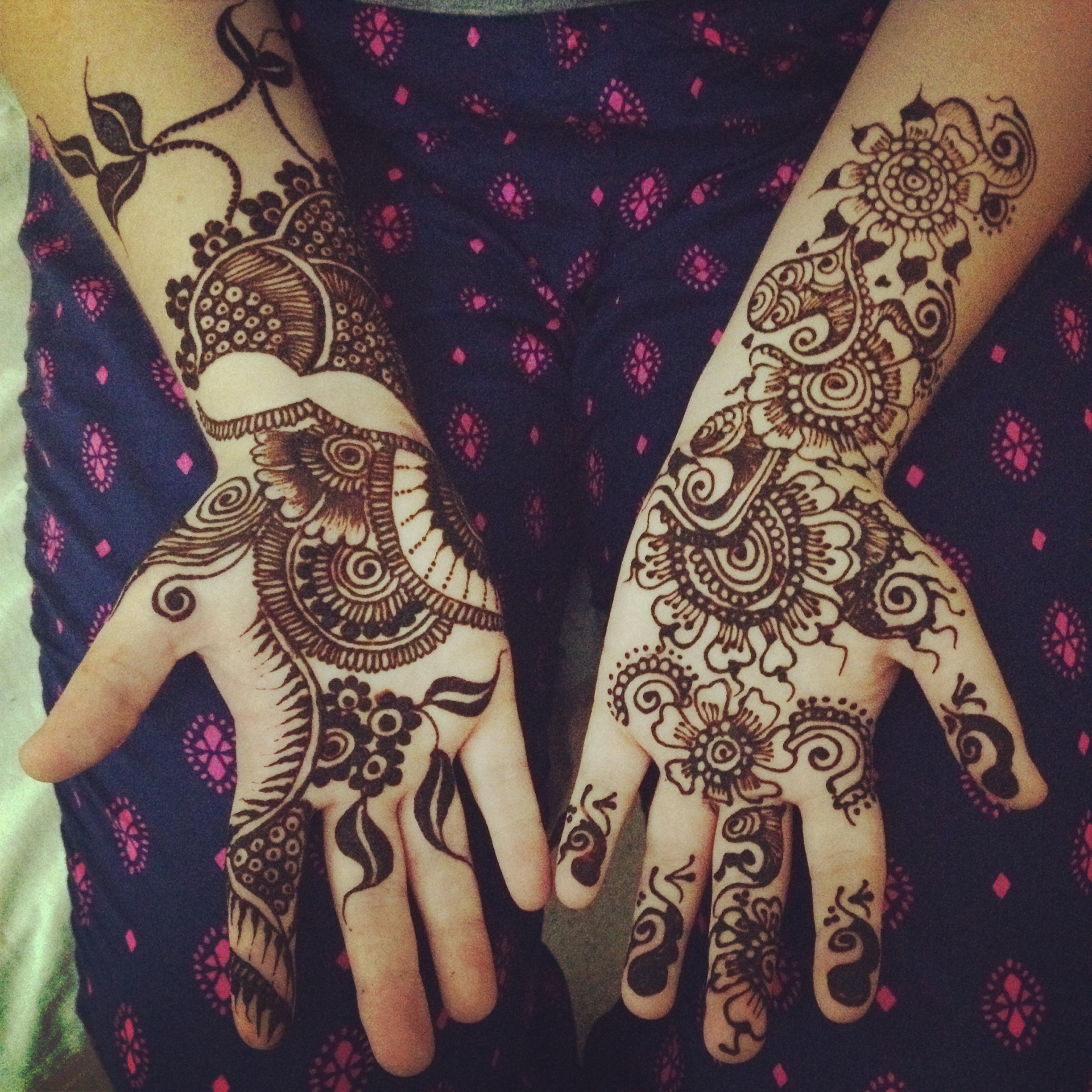
Mustari gets Emma mehndiLike any good grandmother, on our last full day in Bangladesh, Mustari wanted to get everything that Emma’s little heart desired, including jelabis.  While we rested after the morning at the girls center , Mustari went to the best restaurant for these sweets in Dhaka, only to find that they had been cleaned out that morning.  She came back in time to take Emma for her mehndi appointment at the salon that we had made the day before.

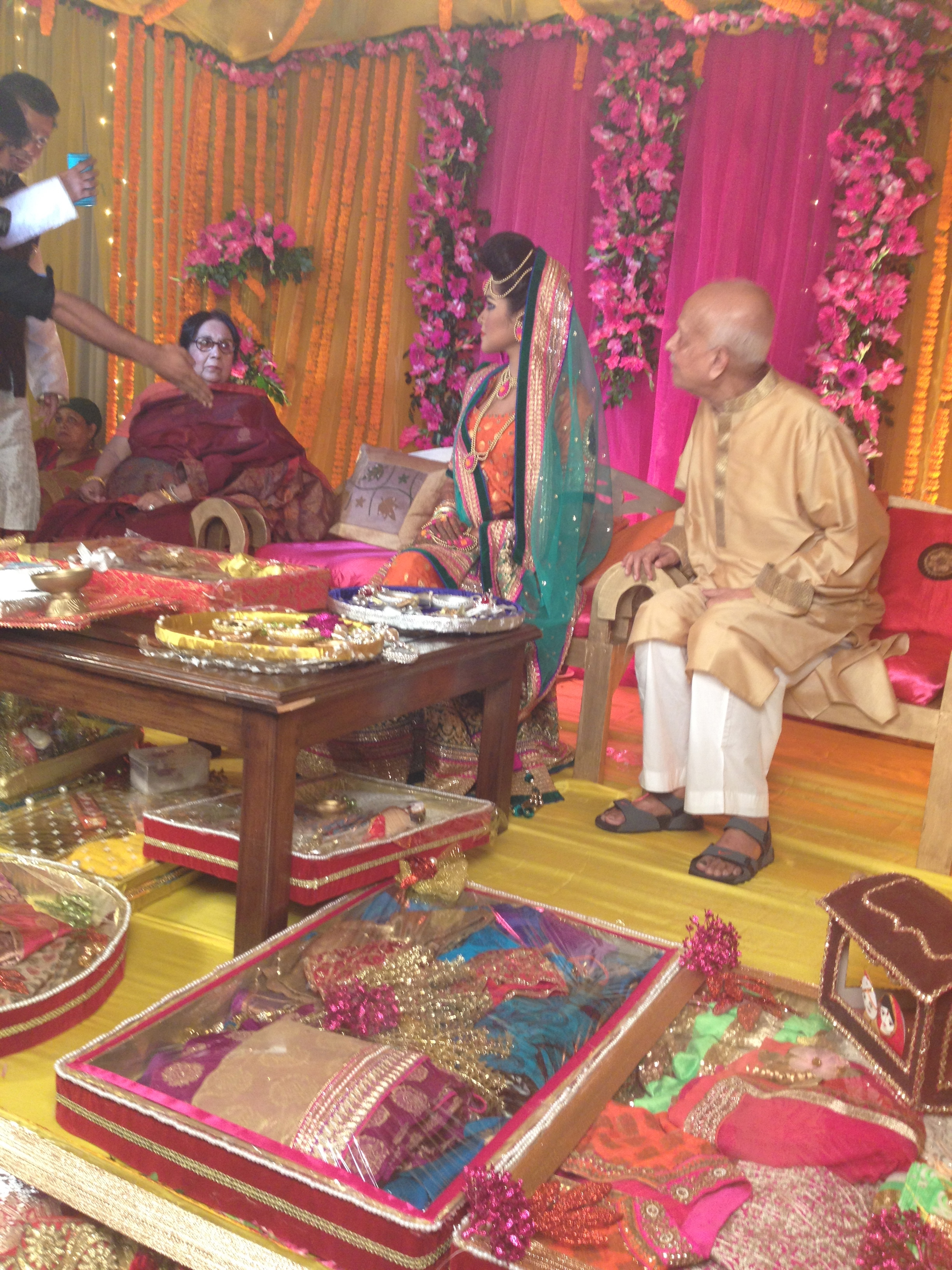
IMG_3823After an early dinner, we spiffed up to go to a wedding shower for a neighbor’s son.  The event was held in a conference center just a block from their home. We walked into an extravaganza.  The walls, the ceiling, the chairs were all decorated in silk and marigolds and twinkling lights hung from every corner.  A dais at the front of the room held a huge shamiana (tent), where the groom sat on a large low couch, filled with silk pillows and brocades.  Guests were dressed to the nines in their best saris and kurtas and each of the groom’s family members came to have formal pictures made with him under the shamiana.   Occasionally, the doors would open and members of the groom’s family came in with huge velvet lined boxes with clear lids, so we could all see the embroidered cloths, silks and jewelry he was presenting to his bride to be. Despite the ancient rituals, it was definitely a modern affair — huge speakers pumped in a mesmerizing melody which reminded me of a swanky bar in L.A., lights dimmed, cameras flashing, beautiful women gliding by in glitter and gold. Only difference in this scene is that instead of martinis, coffee and tea and jelabis were being served, much to Emma’s and Mustari’s delight.

The groom and his family

The groom and his family

A tiny diamond earring, combined with an air of bemused patience, hinted the groom’s time in America.  His friends, all dressed in golden kurtas, took pictures and selfies with him on the dais.  Guests mingled, getting their photos taken  prom style by the ten photographers who roamed the room.

IMG_3838

The bride at the shower

Finally the music signaled a change with sweet Bollywood pop songs.  And then there she was, brought in a golden swan carriage by four men, just like the goddess Saraswati.  The bride was tall, and seemed at least a foot taller because of a huge poof on the very top of her forehead. You could tell she was model good-looking, but the Bengali industrial wedding complex dictated she look like a Bollywood poster.  In other words, Bengali brides fall into the same trap we all do — we never actually look like what we really look like on our wedding day.

We made our exit shortly thereafter.  It would be an early morning for all of us.  Emma and I were headed off to India, to navigate a new city without the strong and loving presence of our Bengali mother and grandmother.

Mustari and Atiq Khan, our Bengali family

Mustari and Atiq Khan, our Bengali family


Friend? Yes, Friends Forever

Meg: Today was a pinnacle experience for us, because we had time to make new friends in Bangladesh.  Mustari took us past Tongi, where she and Mom first delivered family planning services to women in the camps, first to a Smiling Sun Clinic and then to a model village, where all 400 households are creating a community free of domestic violence.

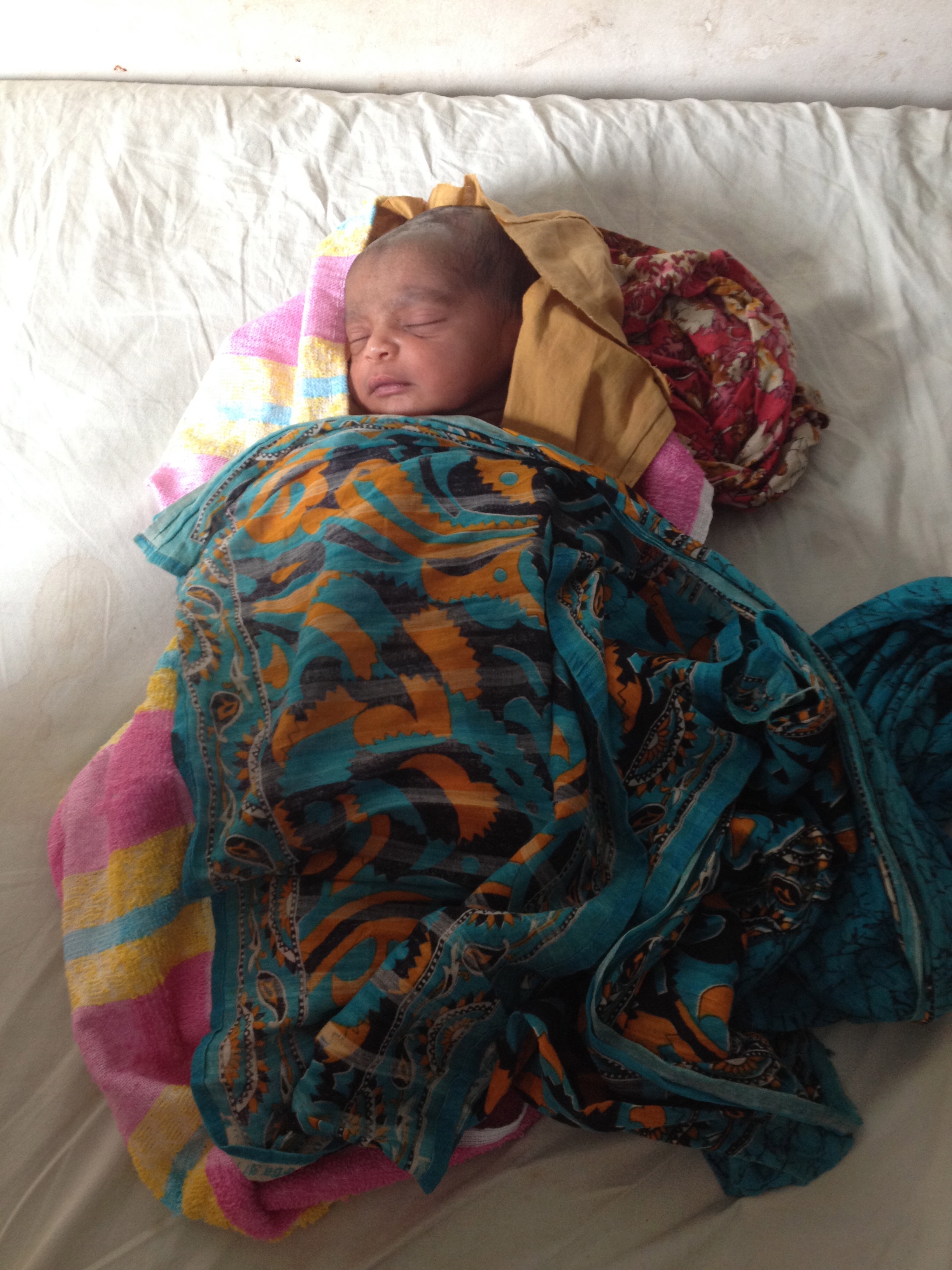
IMG_3716Emma: We arrived at the Smiling Sun clinic to meet the hardworking staff. A young man who was the clinic supervisor was all smiles as he welcomed us for the tour. Just like at Matlab, mom and I were welcomed into a small delivery room were a young woman had just had her first baby by Caesarian section. The baby boy was beautiful. He laid quietly, wrapped in colorful cloths as one of his Aunties watched over him. The mother was peacefully asleep. Without waking his mother, Mustari and I pulled out our iPhones to take hundreds of pictures. The baby was a little celebrity to us. A healthy little boy with his whole life ahead of him.  As we left, Mustari told the staff in Bangla why my mom and I visited. The only words I could understand was “Peggy Curlin’s meye (daughter) and kanna (granddaughter).” The staff nodded with delighted grins on their faces as Mustari turned to us with affection. The young supervisor smiled to me and told Mustari how much I looked like my Nonnie. My mom stated to the group “our choto (little) Peggy.” The whole group smiled and laughed as I blushed to be so honored to have her as my own grandma. 

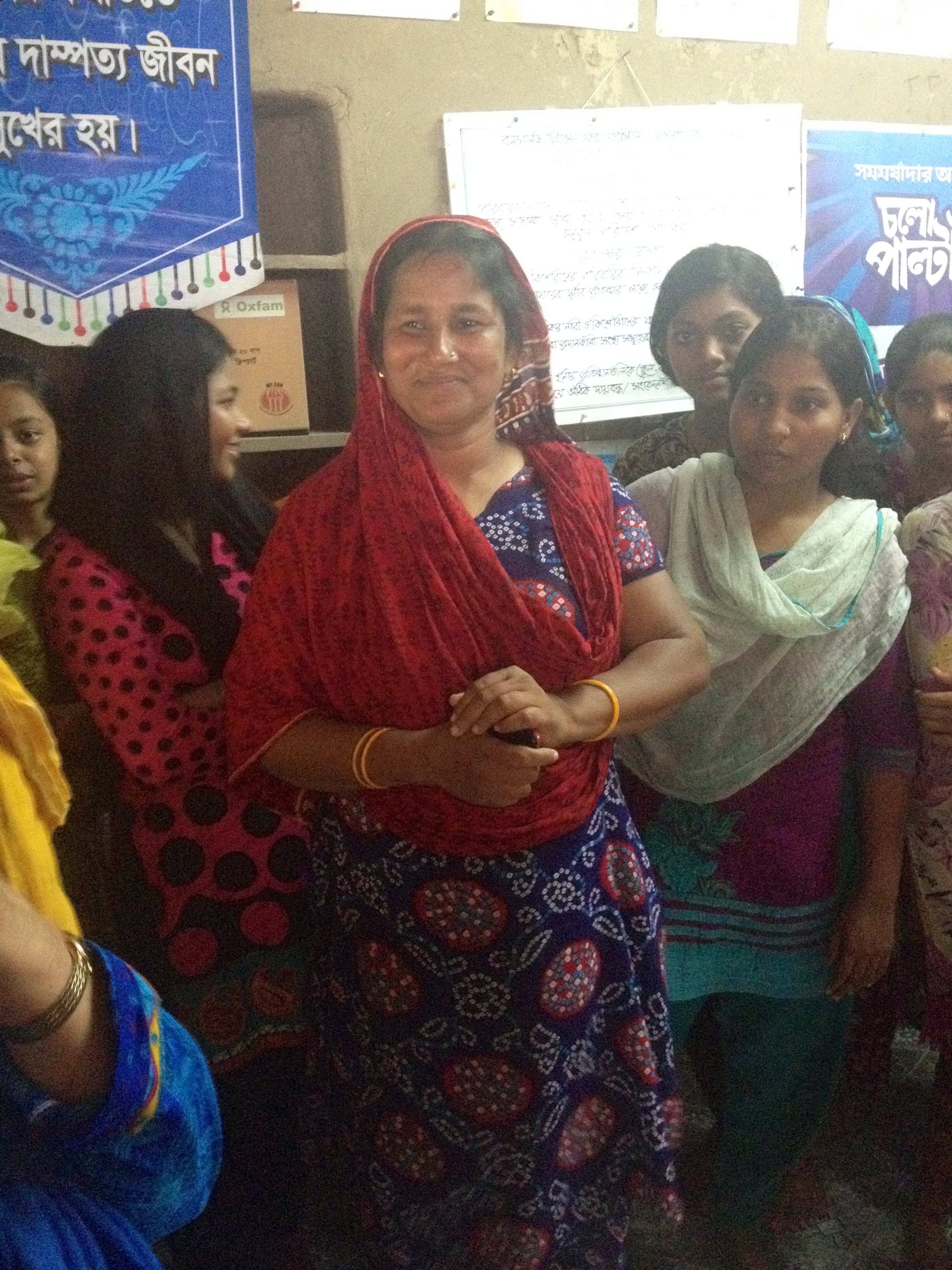
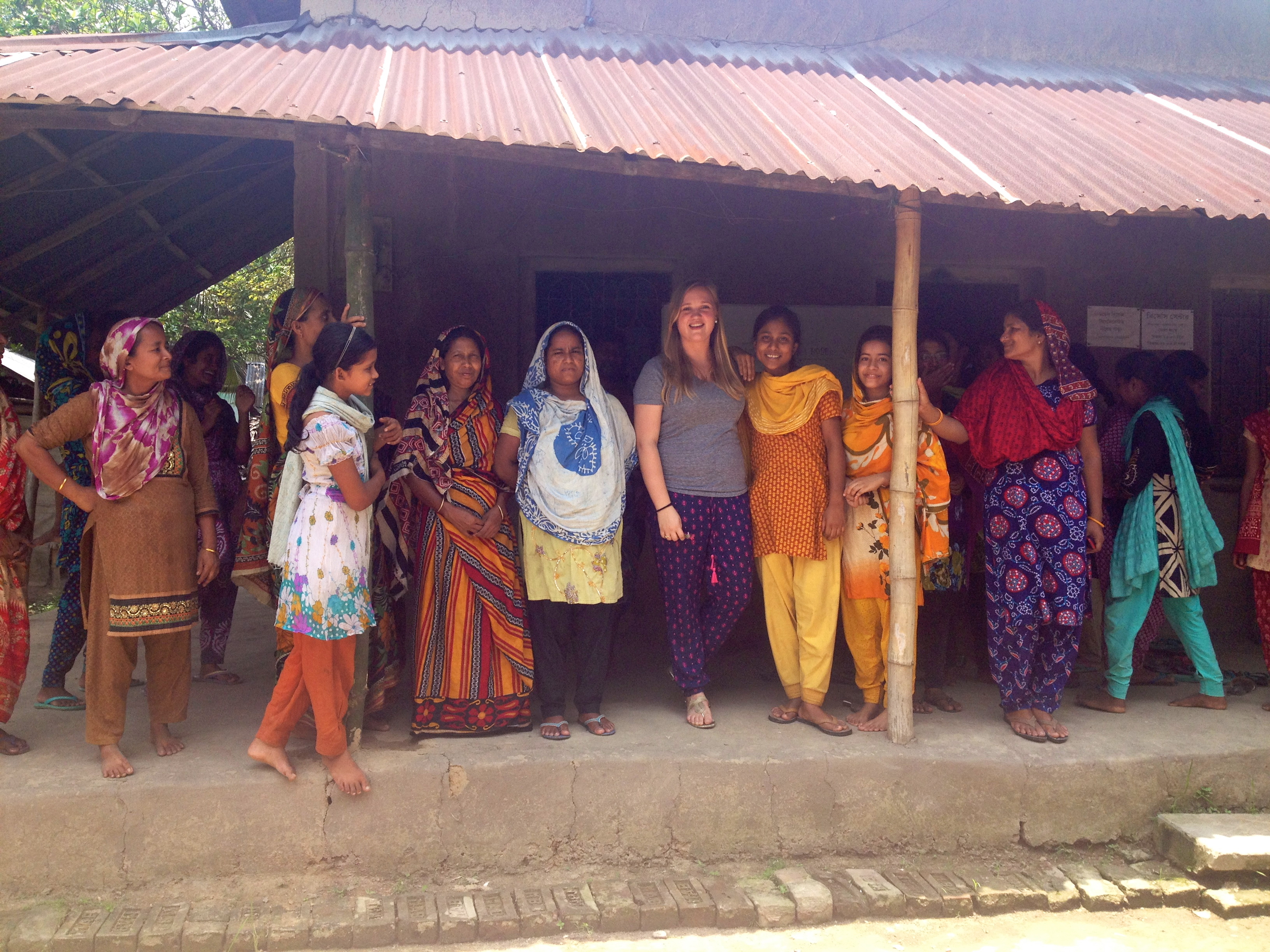
Meg: Then off to the model village after stopping first to pick up another clinic director from the nearest Smiling Sun Clinic. We drove past the small town to where the fields began, past the skinny cows, the herds of goats and the chickens to a small dirt road that led to a compound of huts, one of which was bursting with the energy of about twenty-five girls and young women who couldn’t wait to see Mustari and meet her friends. It is a social center for girls in the village, where they can learn about their rights, develop healthy self-esteem and support one another. An important element in the creation of a village without domestic violence.

Mustari at the Girls Center

Mustari once was a teacher and, tiny as she is, she can command the attention of any group of people with a smile and just the right questions. The girls adored her and answered her questions eagerly, even though all eyes were on Emma, an American girl their age. Mustari took time to translate the posters on the wall for us, which were about how domestic violence and rape were wrong.

Emma: One of the questions I asked Mustari to translate to the girls was “What do you want to be when you grow up?” Some brave girls shouted out their answers. A beautiful girl who sang her own written verses to us wanted to be a songwriter. Her song was about falling in love. Mustari translated the lyrics, “if you were a poet, I am the rhyme; if you are the rain, I am the cloud.” Like any young teenager in love she was confident about her love but most importantly confident in a bright future. Mustari asked if anyone wanted to be a doctor and four very young girls in front shot their hands up in joy. They all giggled to themselves as they tried to reach the sky with their arms. The next question I asked was when the girls wanted to get married. Everyone was confident in their answer. They all agreed that after 18 would be for the best. They had their dreams ahead of them and their priority is to reach their dreams. It was awesome to hear this answer from the girls in the room. One of my main projects interning for the United Nations Population Fund (UNFPA) last summer was supporting the Girls not Brides campaign, ending child marriage around the world. Unfortunately, I heard horror stories about innocent six or seven year old girls who were married off to elderly men as old as 50 in villages just like Tongi. To hear and see the girls from the center lift their voices and take a hold of  their futures is a great triumph. There is now hope for these girls to be able to become the doctors, songwriters, mothers, teachers, and confident women they strive to be.

Meg's hero

Meg’s hero- Shahananan

Meg: The person I most gravitated to in the room was much older than the girls.  At the question about the future, she joked that she wanted to be a movie star, making everyone laugh.  Mustari was taken with her too, and began to ask her questions.  Shahahanan is 36 — married when she was 12, had her children shortly thereafter.  Her husband beat her, so she returned home.  She is now a supporter, a witness, a big sister to the girls in the room.  Mustari asked what happens when there is a hint of domestic violence in the village.  She answered with a smile, “We all protest at the house.” I developed a girl crush.  She is my hero.

Emma: Sadly it was time to go. As mom and Mustari joked with the leader of the center, the young girls gathered around me to practice their English. They were quite good but they especially love one word —  friend. As we all took pictures and got closer together the girls would reach out their hand for a handshake and ask,”friend?” I thought about all the great friends I have and how I now have just gained 20 more beautiful friends. I replied with a smile and a handshake back, “Yes, friends forever.”


Friends forever

The Barge at Matlab Calls to Us

We made it to the Matlab barge

We made it to the Matlab barge

From Emma:  We rose at 4 am still jet lagged from the 22 hour flight but eager for our full day of more  history. With fresh mangos and lychees in our stomachs we jumped into the microbus for a three-hour trip full of twists and turns to the infamous Matlab.

From Meg:  We decided to go to Matlab because that is where my father, Dr. George Curlin, spent a lot of his time when he worked at the Cholera Research Laboratory in Dhaka.  One of my fondest memories of going off to see Dad’s office when I was a girl was the day we rode a speedboat for most of a day to arrive at Matlab.  We spent the night in the barge, where the researchers would stay when they came down from Dhaka to work. Since Emma is interested in understanding the impact a non-governmental organization can have on a community, I wanted her to see the amazing work going on since 1966 at the International Centre for Diarrhoeal Disease Research, Bangladesh (ICDDR,B), serving a subdistrict in Bangladesh called Matlab.    

Emma:  After victoriously escaping Dhaka’s city traffic we began to see the true beauty of the country. At a sharp turn of the small road we passed three young girls walking hand in hand eager on their way to school, men crowded in a small store in morning conversation, followed by a small lake with children joyfully racing while swimming near their mother doing her wash at the edge of the water.

Jamal at the sub clinic

Jamal at the sub clinic

After three hours of a pounding headache from all the curves of the road we were led by Jamal, our tour guide for the day, to one of the village clinics. An elderly lady opens her home to serve the local women and their children. Seven young women patiently waited with their bright yellow infant cards noting all medical information for a baby check up and immunizations. Jamal and the leaders of the sub clinics were proud to show off their impact on the community.

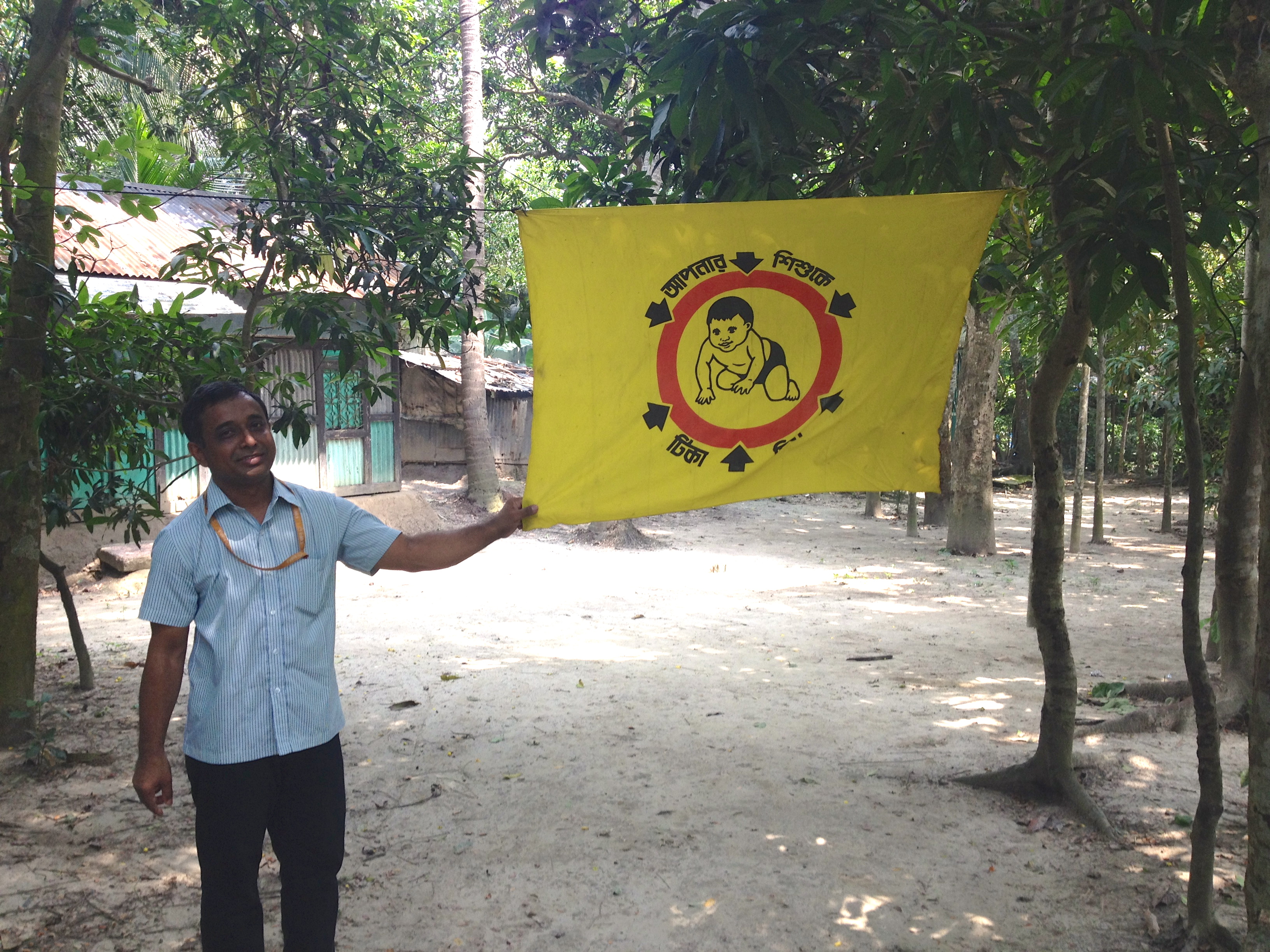
Meg:  ICDDR, B works to reduce the fertility, infant and child mortality rates by offering community health services through substations, where pre- and post-natal check ups, IUD insertion and family planning counseling are done, and in healthy baby clinics, where children have their immunizations, and have a check-up at regular intervals, just like my two children had.   The yellow baby flag tells the community that the clinic in this woman’s house is now open.  Fertility rates in Matlab are down from 5.6 children to 2.3, and infant and under five-year old child mortality rates, once 120 out of every 1,000 births has been reduced to 30, thanks to these interventions.

Emma:  Another 5 miles down the bumpy dirt road we came to a white bridge that led to hope.  The ICDDR,B hospital was full of dedicated and educated young doctors, nurses and researchers working to bring the hope of health to Bangladesh.  And yet there were still many families suffering as a child or a mother recovered from a preventable disease.  It was very difficult to see countless men and women squished into corners of one small room with buckets, not cups, but buckets to take samples of these terrible diseases.

The female ward of the hospital. Some empty beds- a hopeful sign of progress

The female ward of the hospital. Some empty beds- a hopeful sign of progress

Meg:  Before we left for Matlab, Atiq told us a story about his growing up in a village outside of Dhaka.  As a boy he would take joy in watching two older boys fly their kites, battling each other to see who could cut the other’s kite string.  One day, there was only one kite flying after school. Atiq asked what happened to the other boy.  He learned that the boy and his entire family of five had died of cholera overnight.  I remember visiting Dad at the Cholera Research Hospital in Dhaka, during the epidemic years, when cots lined the hallways and there were always people crying out in grief.  So for me, this hospital was the living opposite of what I knew when I was a girl.  Now, according to the wonderful medical director who took us for the tour of the hospital, cholera is less than 10% of the cases they see at the hospital and 90% of the patients they treat there are from outside Matlab, where community health education and services are greatly reducing these diseases. 

Emma:  As we walked and talked with the Medical Director of the hospital and learned about how mortality from these diseases has fallen to record lows, I felt hope and peace. At the last leg of the hospital tour, my mother and I were welcomed into a small room that we thought was to be another research room, but behind the curtain was a woman in

Nine centimeters- the baby is almost here

Nine centimeters- the baby is almost here

labor. I tried to wipe the stunned look off my face as we were asked to stand by her side. She was calm. Her mother, in her beautiful turquoise sari, nodded to my mom and I as the nurse explained the woman was 9 centimeters dilated. Nine centimeters! She laid unbelievably calm and even had the energy to crack a small grin to us and the nurses as she knew she was in good hands.

Meg:  We took such hope with us out of that small delivery room. The mom and her baby have a better, brighter future, thanks to the talented and dedicated staff of the ICDDR,B.  As we stepped onto the barge where my father and his colleagues would spend the night, under their mosquito nets, I was so proud of him and the work he did to positively affect the health and wellbeing of the people of Bangladesh.


The tremendous impact from 1966 to the present day, through war, famines, cyclones and political unrest, all trends remain headed in the right direction.

The tremendous impact from 1966 to the present day. Through war, famines, cyclones and political unrest, all trends remain headed in the right direction.

A Day for Remembrance and to Remember

ImageWe arrived in Bangladesh at 5 am today on what amounted to a party plane from Doha. Half of the plane was families with kids. The Dads gathered around each other’s seats to talk, the kids were up very late watching Tom and Jerry cartoons on the seat back TVs.  Everyone had a duty free bag from Doha, the only airport in the world that features a duty free Bentley for the taking. Emma and I laid all over each other, trying to get enough sleep — we didn’t want to change the plans for the day just because we were twelve hours late.

Atiq had risen early to get us and paid a person in the airport visa office to get us off the plane and expedite our in country visas.  The weather was like New Orleans after a rainfall in August.  Soupy, swampy, thick.  The airport was the same as I remember when I was a girl.

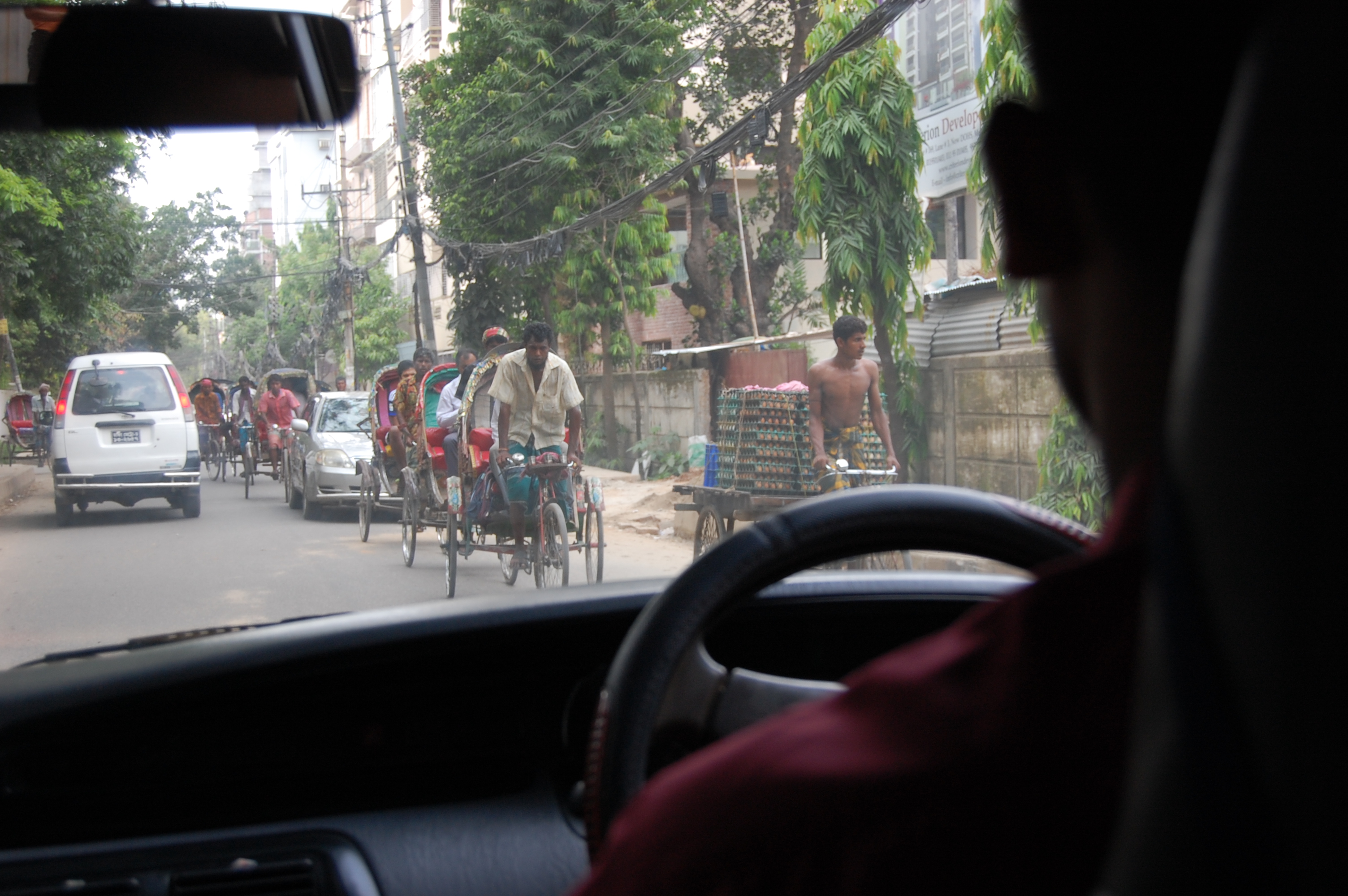
Even at 6 am, the traffic was getting pretty bad and Emma and I figured out that Bengali drivers use their horns to signal 1) that they are not going toImage be driving in a lane, since there are no lines painted on any road, including highways 2) that they are coming up on you very fast, you better get out of the way and 3) that they are incredibly close to you when they pass.  Our driver preferred what I began to call the roadrunner method.  Come up on a motor scooter with a mom and baby on the back without helmets, “beep! beep!” then zoom around.  Repeat with a bus or rickshaw — in the way and going in the wrong direction on a one way street.

After a beautiful breakfast with Mustari and Atiq, we headed off to Concerned Women for Family Development with Mustari, where she is President.  We first visited one of 21 clinics funded by USAID, met with the staff and learned about the Ward in which they work.  Such amazingly gifted and loving women.  We had the tour of the facility and returned to Mustari, who was deep in conversation with a girl, aged fifteen.  Mustari told us that the girl had been married for three years.  She is now 5 months pregnant.  It was obvious that Mustari was frustrated with the situation.  She is just a girl.

Image

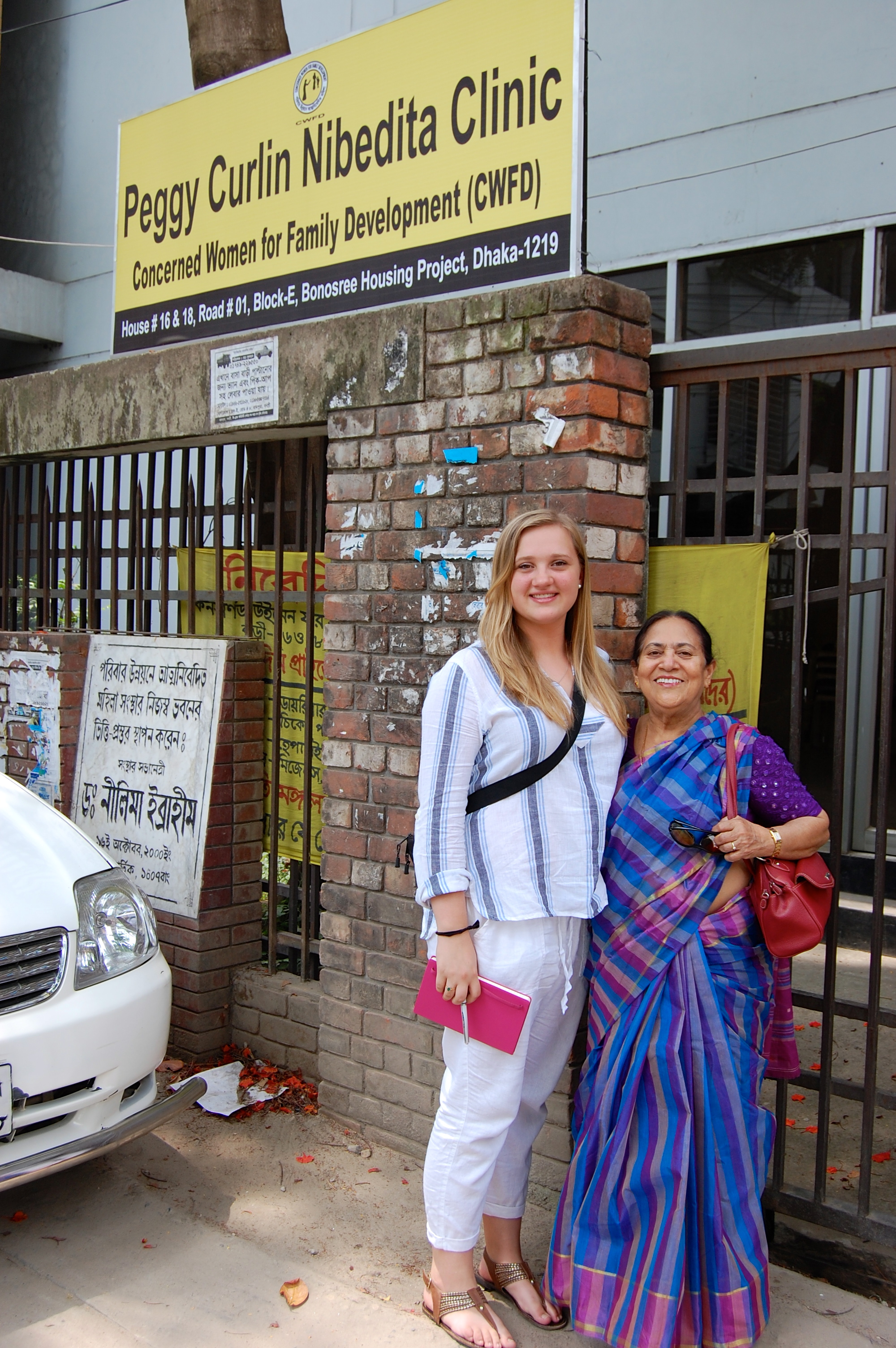
Emma and Mustari at the CWFD offices in front of the sign about Mom’s namesake.

Then onto the Concern Women for Family Development building, which houses the family planning clinic that is named for Mom. A pilgrimage for us.  So many good memories were shared about the founding of the NGO, by the friends Mom made along the way who are still there, still giving their lives to help women, almost forty years later. Then a beautifully prepared lunch with Peggy in mind — Mustari had prepared fried chicken and tea sandwiches.  Hearing that I like hot curry, the ladies then produced a bowl of hot fish curry and some bhat — rice.

Bangla is coming back to me slowly.  I find that I am instantly recognizing words — chole for “let’s go,”  jabho for “go.”  I remembered a nursery rhyme today “Pripra Pripra coita deem?  Ekta, duta, teenta deem!”  It delighted me and the ladies at CWFD.

After a nap, shopping at one of the most pakka department stores in Dhaka for kurtas to wear to the field tomorrow.  We head off to Matlab, where Dad did his research to see how it has grown. Up at 6:15 for doi (yoghurt), mango and naan and on the road until 7 pm tomorrow night.  Can’t wait for more adventures.